
While the ‘higher for longer’ backdrop has been shaped by rising economic nationalism, themes such as resources, reshoring and rearmament, the 3 R’s, have been key drivers of sector performance. David Jane explores how these forces are influencing markets and where opportunities may lie beyond the dominant AI narrative.
For some time, we have had a basic thesis that we are in an era of ‘higher for longer’ driven by increasing economic nationalism. The US’s determination to retain its global hegemonic status are driving it and others to act across a number of areas that impact the stock market.
We would categorise these across three major fields; resources, reshoring and rearmament, the 3 R’s. There is, of course, considerable overlap between these areas. This has had notable impact on how sectors have performed over the past year. Those areas favoured for investment by the big geopolitical players have typically seen stronger performance.
Subhead 1
The first and arguably the most important is resources, control of the world’s energy resources give a nation (or empire) significant leverage over its adversaries. The US’s actions in the Middle East, Venezuela and elsewhere can be viewed in this context. We should not overlook other critical resources. However, increasing the supply of critical minerals and supply of even basic metals such as copper, is important to the US’s ambitions across multiple fields such as AI and defence.
Subhead 1.1
The US has been investing to bring key industries closer to home, particularly to reduce the reliance on China in fields such as semiconductors and other intermediate goods that are critical to its military and AI ambitions. We have seen significant investment in datacentres, semiconductor fabrication facilities and other economic infrastructure. The recent designation of electrical grid infrastructure equipment as critical for national defence purposes may support this further. The US views the datacentre buildout as important for its competitiveness, including its military competitiveness.
Recent conflicts have highlighted that, while still globally dominant, the US military capability may be lagging behind technologically, particularly in the area of drone warfare. Increased investment is expected to take place in coming years to reinforces its status. It is not just the US that is in this race, Europe and Japan join as allies in the defence spending race. China and others are running in the resources and technology race. These trends have had a material impact on relative sector performance as shown in the chart.
The chart shows one year performance for a selection of key sectors.
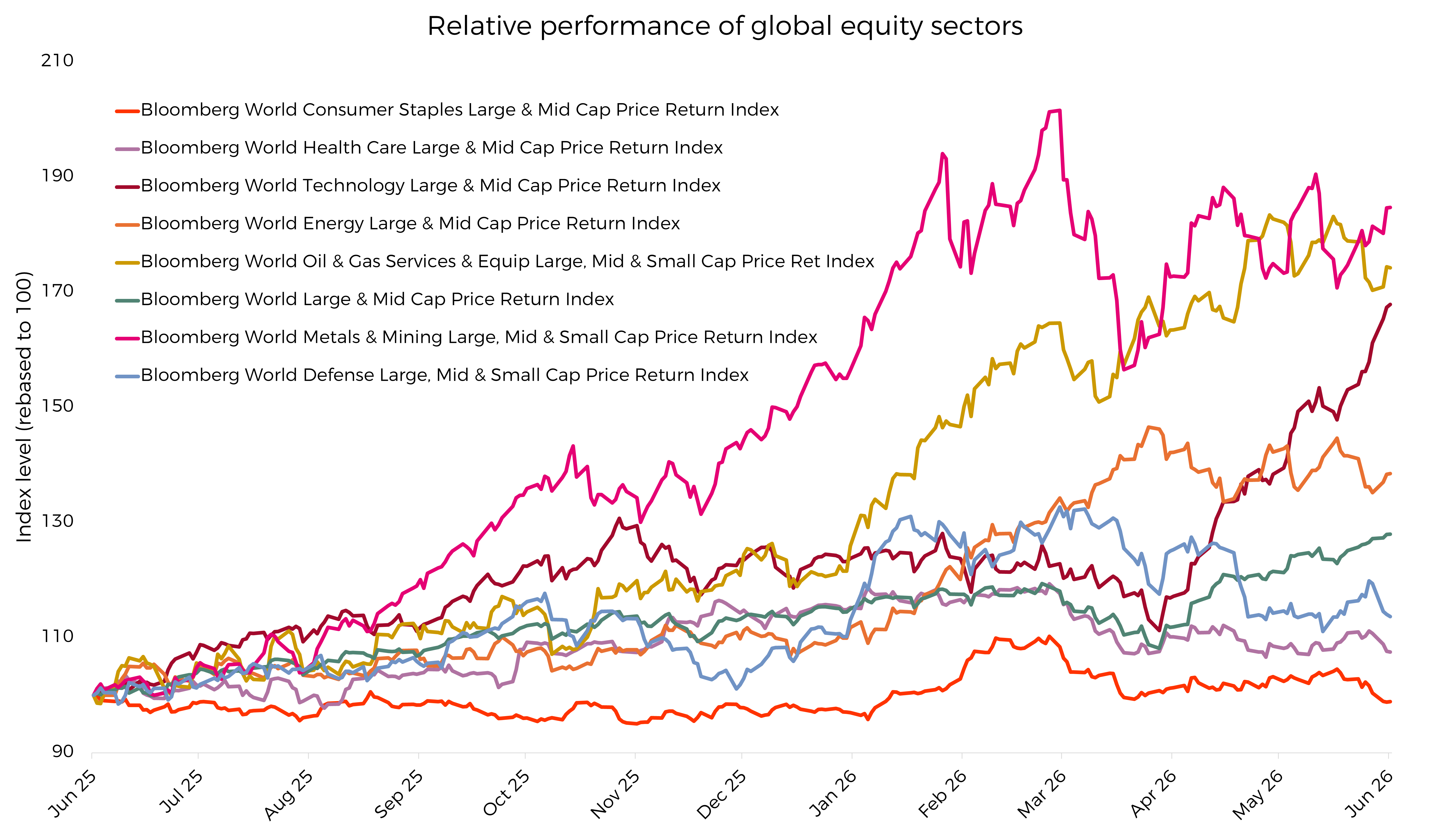
Source: Bloomberg, data from 03.06.25 to 03.06.26. Past performance is not a reliable indicator of future returns
Subhead 2
Areas exposed to these key trends have generally performed more strongly, while there has been more muted activity elsewhere. It has been suggested that the only game in town is the AI trade, we would suggest this is only partly true. The only game in town is the economic nationalism trade, of which the AI trade is just one part.
This does create a dilemma for investors, market returns are concentrated in a small number of sectors which, in the case of materials and energy, some investors have actively avoided for a considerable period of time. Despite this it is still possible to run a well-diversified portfolio across diverse parts of the market successfully.
At the same time, we are always looking for new opportunities. Clearly, the lack of interest in the rest of the market is throwing up some extreme valuations, particularly in areas such as consumer staples. Heavily out of favour, due to issues such as cost price inflation, consumer budgets and weight loss treatments, they now often sit at valuations that look appealing. Our approach as ever will be to look for emergent price momentum before getting heavily involved.
David Jane
Premier Miton Macro Thematic Multi Asset Team